Software Engineer → Product Manager
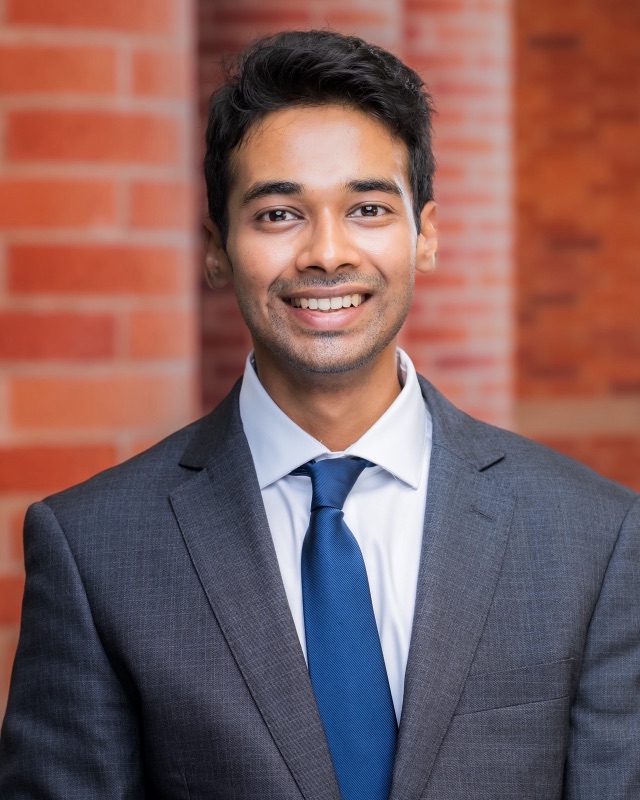
UCLA Anderson MBA '28. Four years as a Senior Software Engineer at Visa, turning bank requirements into the APIs behind a B2B payments platform, and building a 6-agent review tool with two other engineers. Now I build AI prototypes to practice owning the product calls, not just the code.
UCLA Anderson MBA '28 · Columbia M.S. Computer Science · ex-Visa
Merit Fellowship Awardee · 3 AI prototypes built solo, each with a live demo and code
By the numbers
About
I spent four years as a Senior Software Engineer at Visa, helping launch Visa Accounts Receivable Manager (V-ARM) — Visa's B2B virtual card payments platform.
Before that, I earned an M.S. in Computer Science (ML specialization) from Columbia University and a B.Tech. in CS from NIT Trichy. I'm now at UCLA Anderson's MBA program to make the full transition into product management.
Now I build AI prototypes for payments and enterprise workflows, each with a live demo and code. For each one I write down the calls that matter in AI products: which model and why, what it costs, how sure it has to be before anyone acts on it, and what a person still owns.
Each case study shows the user problem, the product calls I made, and the result. The first is V-ARM, which I helped launch as an engineer at Visa. The next three are AI prototypes I built solo, with live demos and code. The last is a team build for a case competition, where the AI is simulated.
V-ARM (Visa AR Manager) · Visa's B2B virtual card payments platform
Commercial Money Movement Solutions · translated product requirements into the integration contracts and APIs that launched V-ARM.
Launching a B2B virtual card platform meant turning issuing and acquiring bank requirements into integration contracts and APIs that issuers, processors, and engineering could build against — while two separate schedule risks threatened the launch date.
Flagged a 20% throughput loss early enough to ship a phased MVP on time, then recovered a one-month security delay by restructuring sequential work into parallel execution across Engineering and Cybersecurity. Later rebuilt localization as a configuration-driven framework to unlock the European launch.
$17.8M in first-month virtual card volume · on-time launch despite two schedule risks · 2 new markets with zero code changes
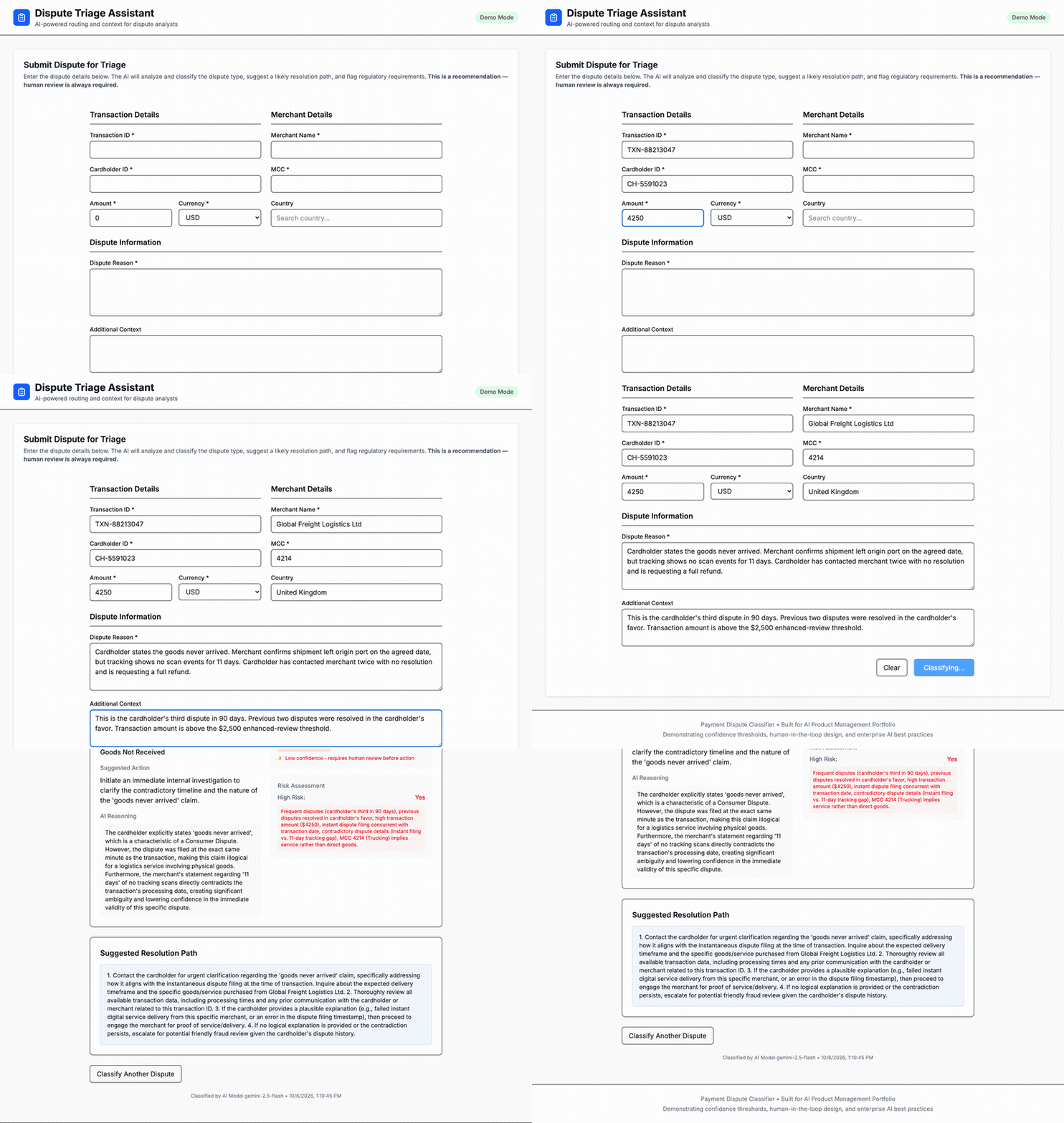
Triage assistant for bank dispute analysts — AI that recommends, never decides alone.
Dispute analysts read unstructured dispute text and cross-reference resolution playbooks case by case, and different analysts classify the same dispute differently. My sizing: 5,000 disputes a month at 20 minutes each is about $125K a month in analyst time for a mid-size bank.
Built a triage assistant that classifies a dispute into 5 categories, suggests a resolution path, and flags possible regulatory review. The model returns a score, but the tiers are set in code, not by the model: HIGH at 90%+, MEDIUM at 75–89%, LOW below 75%. The prompt defines what evidence earns each band. Every result goes to an analyst, and LOW cases are marked for mandatory full review.
≤15 seconds per case across 30 timed test disputes · one pass returns category, reasoning, resolution path, and regulatory flag · the analyst makes every call
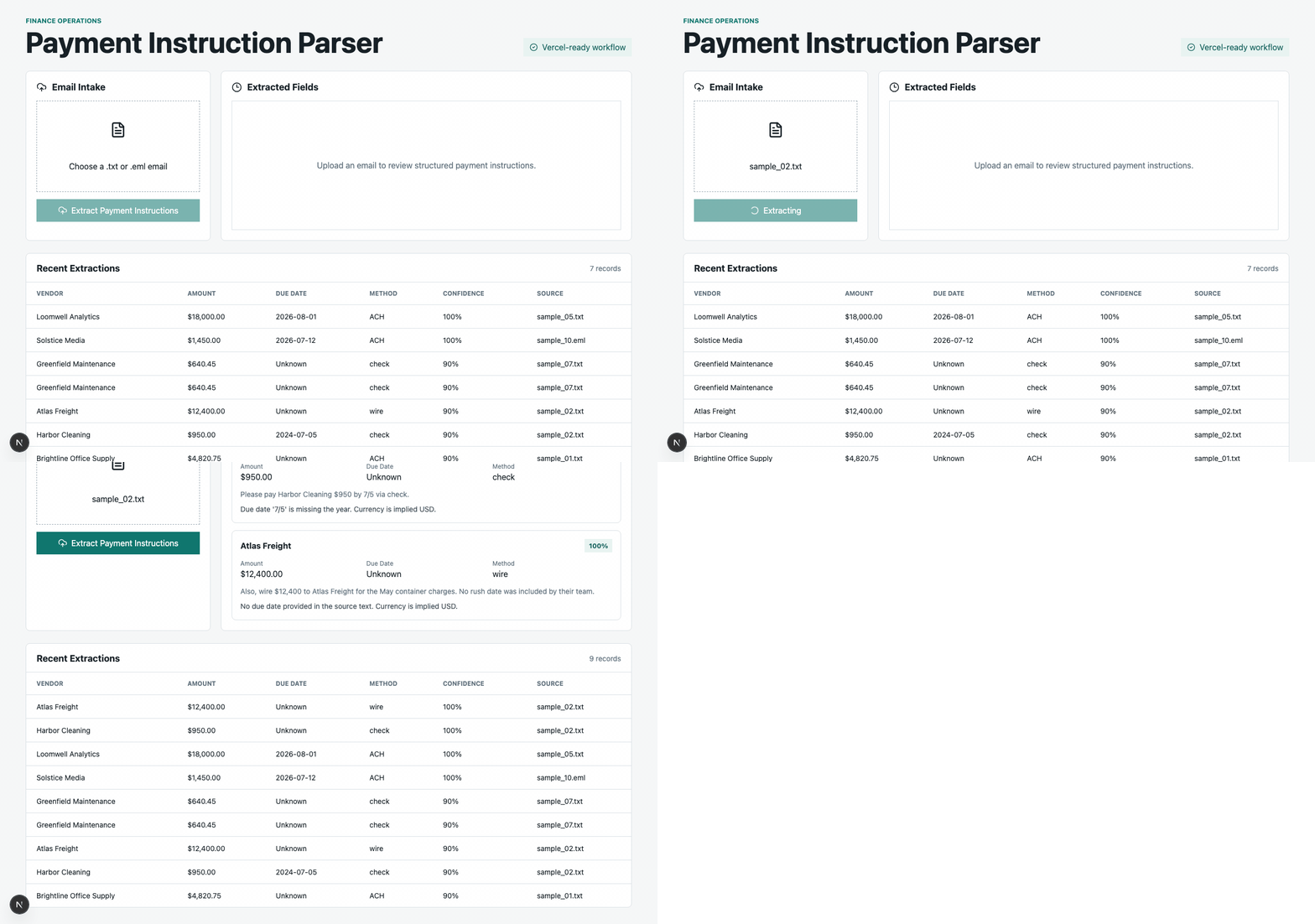
Extracts structured payment data from messy .txt and .eml emails with confidence scores.
Finance teams receive payment instructions through messy email threads, forwarded invoices, and informal reminders — manual extraction risks missing due dates, vendors, or payment methods.
Built a finance tool that accepts email uploads, extracts structured payment instructions via LLM structured outputs, and stores results in PostgreSQL for review and audit.
Reduces manual data entry · handles multiple payments per email · audit-ready extraction history
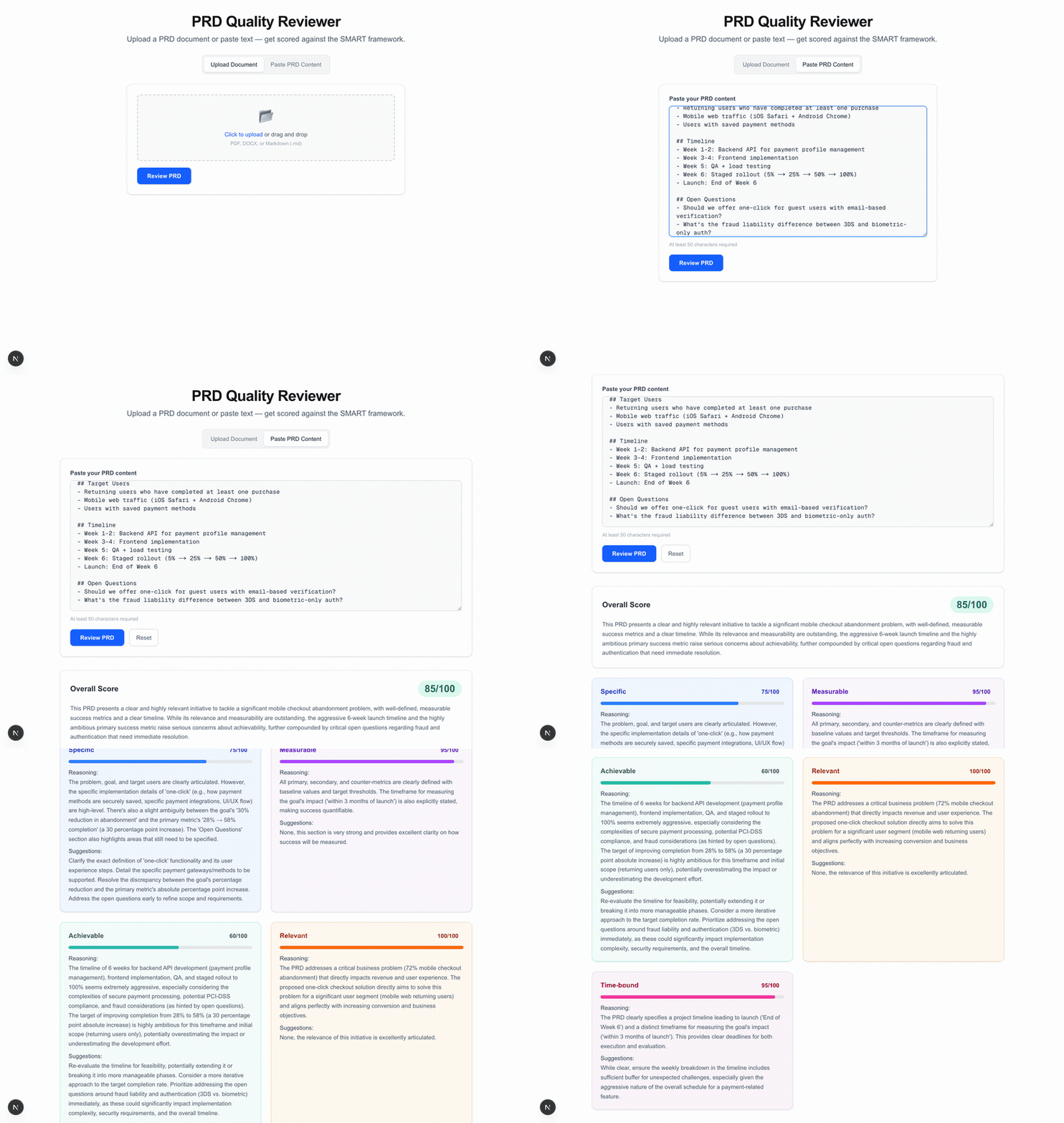
Scores a PRD (pasted, or uploaded as PDF, DOCX, or Markdown) against the SMART framework, with reasoning and a suggested fix for each criterion.
PRD quality varies widely, from precise, data-driven documents to vague wishlists. Unclear requirements turn into rework once engineering starts, and there's no fast, consistent first-pass check.
Built a Gemini-based reviewer that scores a PRD 0–100 on each of the 5 SMART criteria and returns the reasoning and a suggested fix for each. Tested it on 5 sample PRDs written to range from poor to excellent.
Per-criterion scores and fixes in seconds · live demo · 5 sample PRDs of known quality in the repo
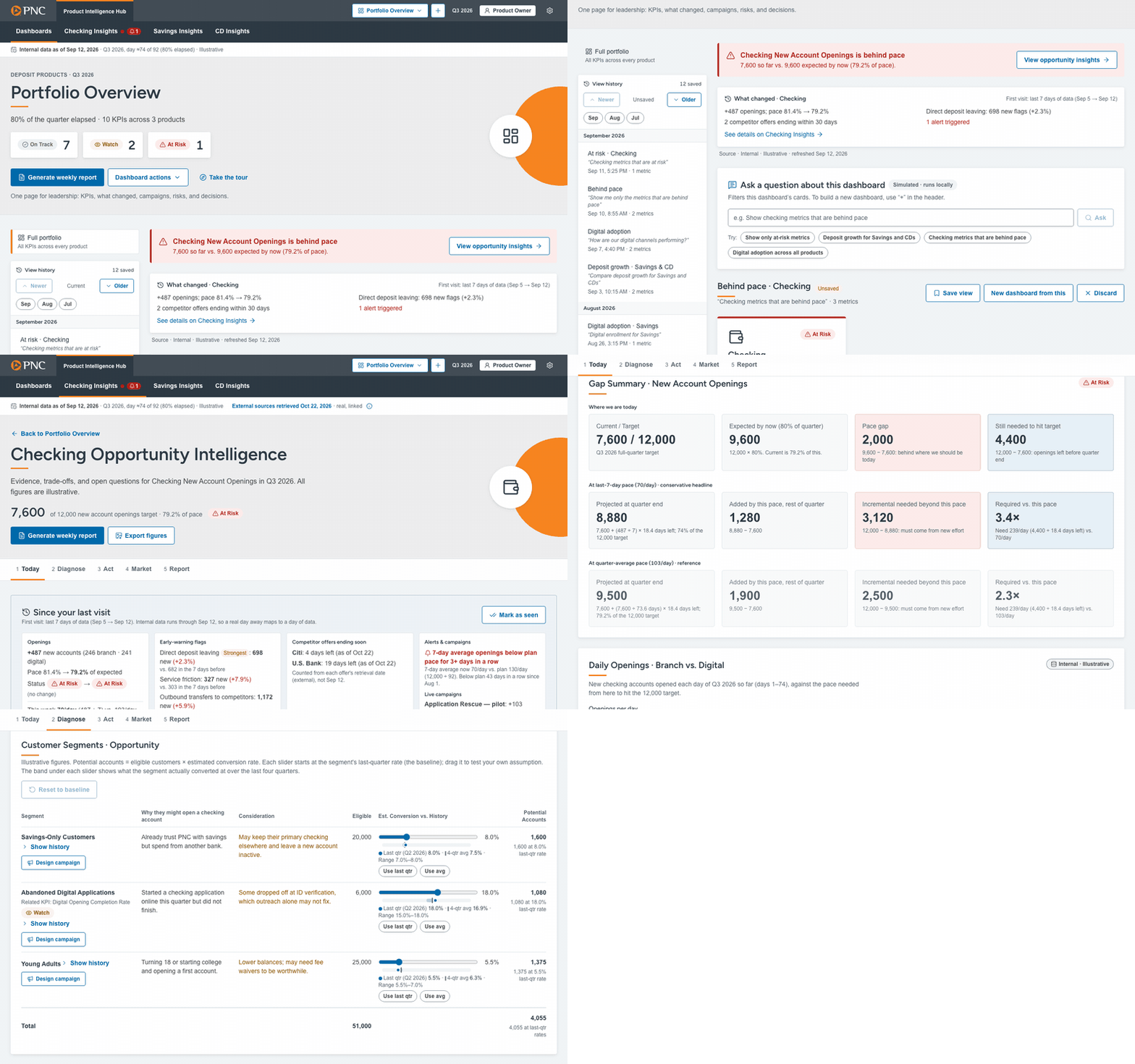
2026 Tepper Tech Innovation Challenge (CMU), sponsored by PNC · an AI decision-support tool for the Product Owners who run PNC's consumer deposit products.
PNC asked MBA teams to design an AI-powered Product Ownership framework. Its deposit Product Owners must balance growth, risk, and compliance, with data spread across many systems. A PO tracking Checking, Savings, and CD KPIs can see a number is low, but not whether it's behind pace, by how much, or which customers could close the gap.
Wrote the product spec and scaffolded the app around one shared data model, so every page derives status, gap, and opportunity from the same numbers. Built the Portfolio Overview: pace-based status, a prompt bar that turns plain-English questions into focused dashboards, and saved views. For the demo, the prompt bar runs on keyword rules so it works offline; a real model can replace one function without changing anything that calls it. A teammate built the per-product opportunity pages on top.
Live demo on GitHub Pages · at-risk KPI flagged from pace (79.2% of expected) · segments sized from history, not guesses
Experience
Jul 2022 → Jul 2026
Visa
Senior Software Engineer, Commercial Money Movement Solutions
Atlanta, GA
Jun 2021 → May 2022
E3B Department, Columbia University
Graduate Research Assistant · Environmental science & policy program
New York, NY
Oct 2020 → Dec 2020
Flatworld Solutions
Analyst Intern · Global automation, AI, and software consulting firm
Bangalore, India
Community
Volunteer
Atlanta, GA
Education
2026 → Jun 2028
UCLA Anderson School of Management
M.B.A., Full-Time Program
Los Angeles, CA
2021 → Jun 2022
Columbia University
M.S. Computer Science, Machine Learning Specialization
New York, NY

2016 → Jun 2020
National Institute of Technology, Trichy
B.Tech. Honors, Computer Science, Economics Minor
Trichy, India
Technical fluency
Get in touch
I'd like to hear from teams building AI products and the platforms under them, especially in payments and fintech.